Table of Contents
FreeRTOS Memory, Task, and Interrupt Management
Kernel source files
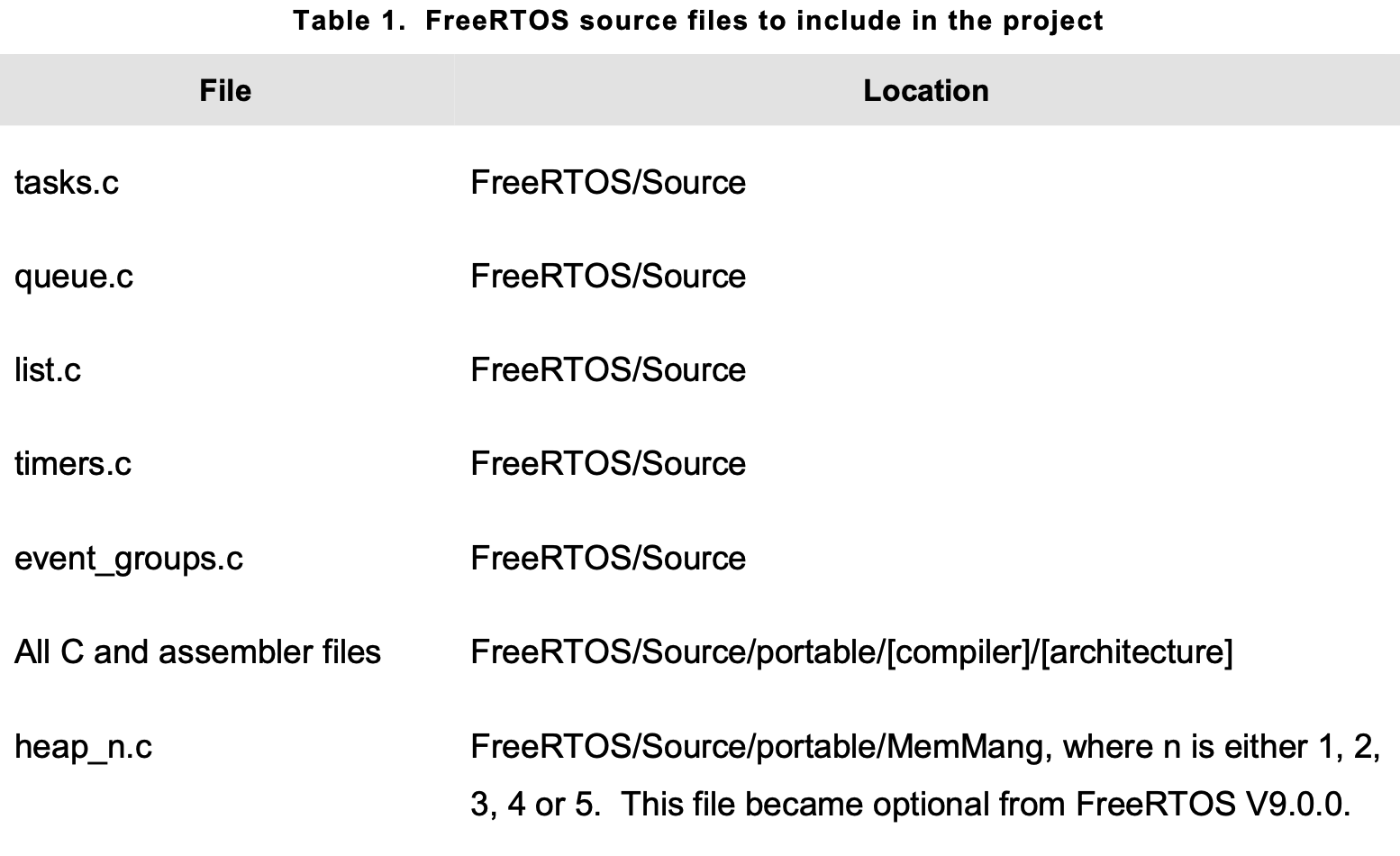
A minimal FreeRTOS kernel build normally includes tasks.c, queue.c, list.c, a platform-specific portable/<compiler>/<architecture>/port.c, and one memory manager such as heap_4.c. Include files such as timers.c, event_groups.c, and stream_buffer.c when their corresponding features are enabled.
Data types
TickType_t stores the kernel tick count used for timeouts and delays. Its width is controlled by the port and kernel configuration; a narrower type wraps sooner and is not a universal recommendation for smaller processors.
BaseType_t is defined as an efficient signed type for the target architecture. It is typically 32-bit on a 32-bit architecture, 16-bit on a 16-bit architecture, and 8-bit on an 8-bit architecture.
Variable and function names
The kernel’s naming convention uses prefixes such as c for char, s for int16_t, l for int32_t, and x for BaseType_t or other non-standard types. An unsigned variable also receives a u prefix, while a pointer receives a p prefix. For example, a uint8_t variable uses uc, a pointer to char uses pc, and v denotes void.
Heap memory management
Why not use the standard malloc() and free() directly?
Depending on the C library and target, they may be unavailable, relatively large, non-thread-safe, non-deterministic, or prone to fragmentation.
Use pvPortMalloc() and vPortFree()
FreeRTOS provides five sample memory-manager implementations in heap_1.c through heap_5.c.
The kernel calls pvPortMalloc() when it needs dynamic memory and vPortFree() when the selected allocator supports deallocation. Their interfaces resemble the standard C library’s malloc() and free() functions.
heap_1
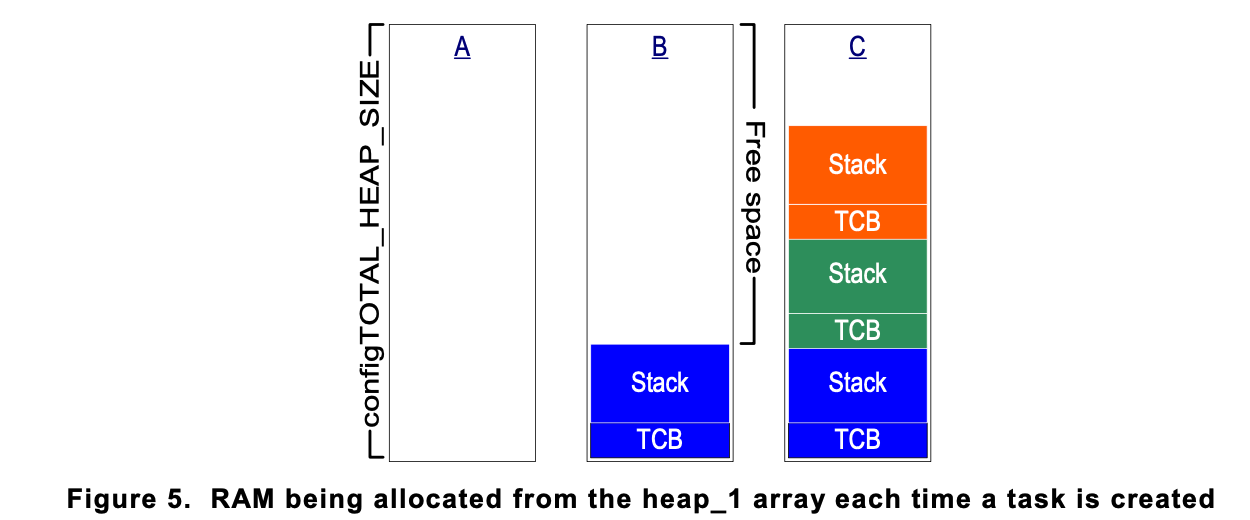
- supports allocation but not deallocation
- objects can be created after the scheduler starts, provided they are never deleted and enough heap remains
heap_2
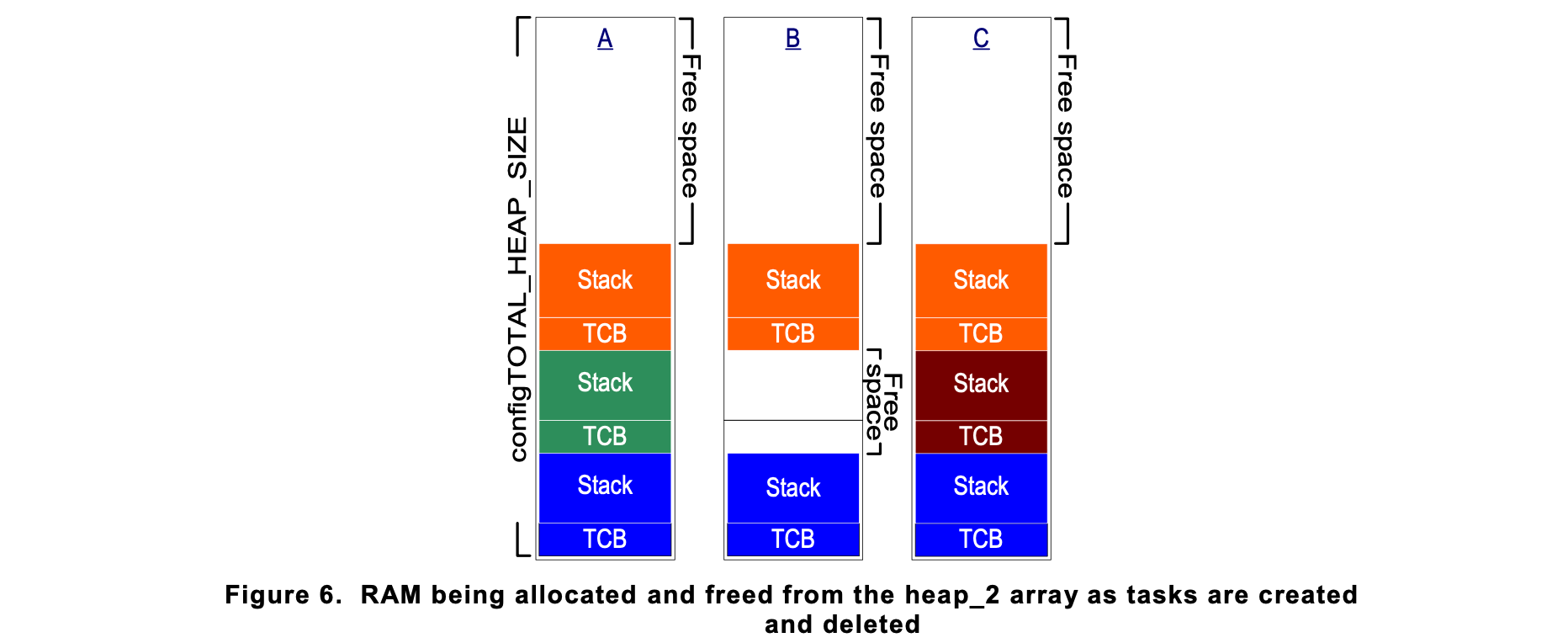
- retained for backward compatibility and not recommended for new designs
- uses a best-fit algorithm to select the smallest free block that satisfies an allocation
- suitable only for limited allocation patterns because it does not coalesce adjacent free blocks
heap_3
- wraps the standard library’s
malloc()andfree(); the linker configuration defines the available heap, andconfigTOTAL_HEAP_SIZEhas no effect
heap_4
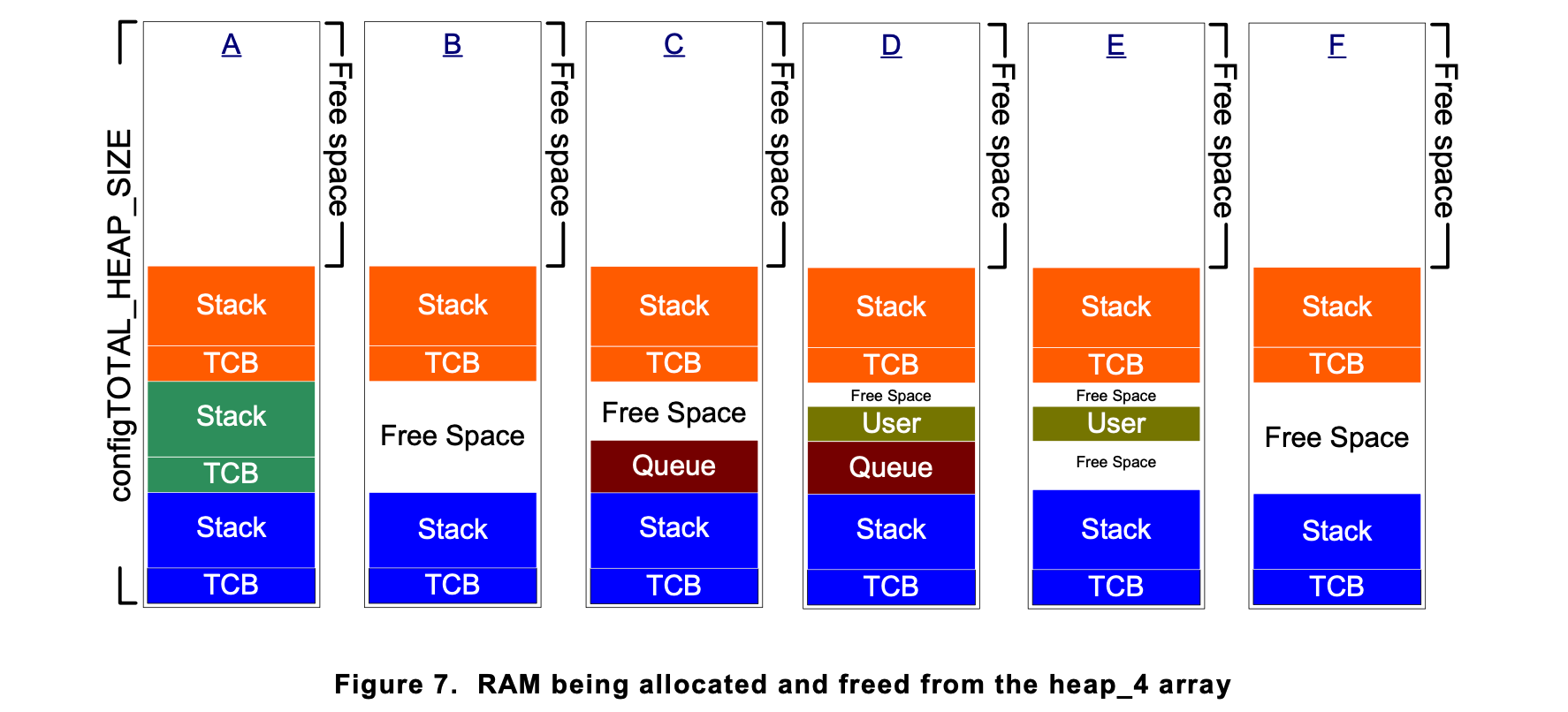 C shows the state after a FreeRTOS queue has been created. D shows the state after the application has called
 pvPortMalloc() directly.
- the array is statically declared, and dimensioned by configTOTAL_HEAP_SIZE
heap_4coalesces adjacent free blocks into a larger block, which reduces external fragmentation.- Note that, unlike when heap_2 was demonstrated, the memory freed when the TCB was deleted, and the memory freed when the stack was deleted, does not remain as two separate free blocks, but is instead combined to create a larger single free block.
- Its execution time depends on the state of the free list, so it should not be treated as strictly constant-time.
Start address for heap_4 can be set.
heap_5
heap_5 is almost identical to heap_4, except that:
- it can allocate memory from multiple non-contiguous regions instead of one statically declared array;
vPortDefineHeapRegions()must be called before creating any kernel object.
Task management
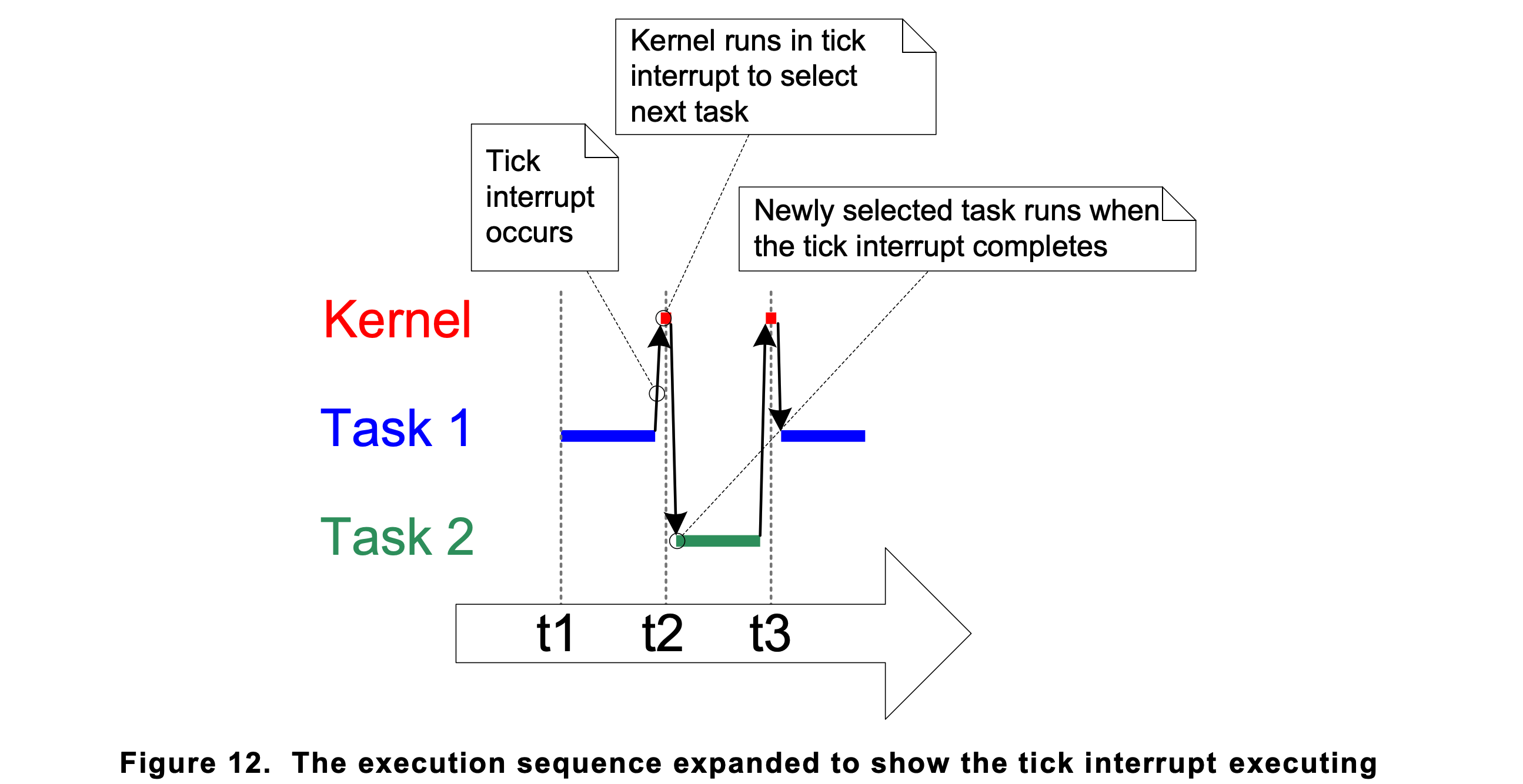
- FreeRTOS tasks must not be allowed to return from their implementing function in any way—they must not contain a ‘return’ statement and must not be allowed to execute past the end of the function.
- The FreeRTOS scheduler is the only entity that can switch a task in and out.
- with time slicing enabled, the scheduler can rotate between ready tasks of equal priority on tick interrupts
States
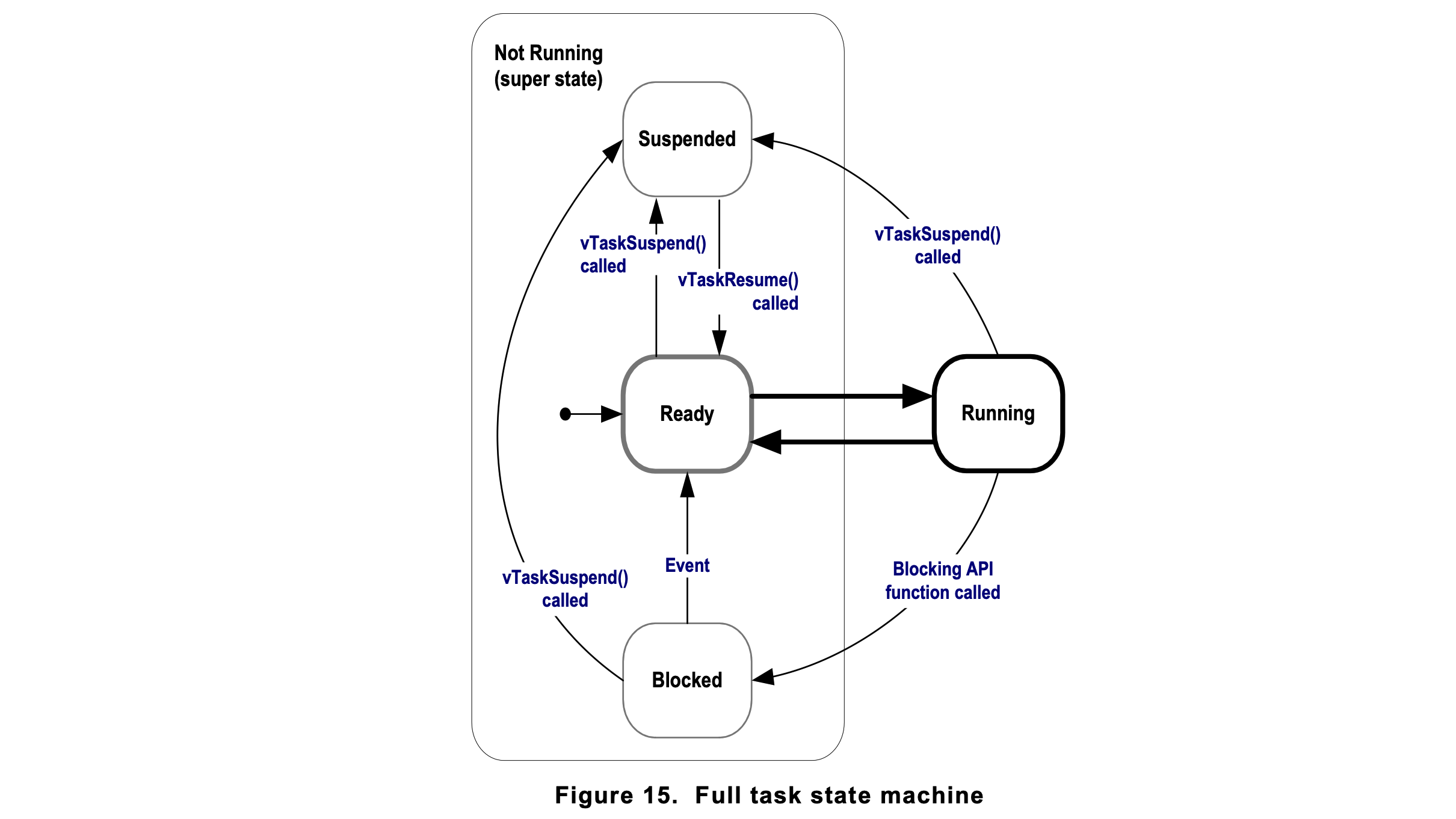
The Blocked State
Blocked tasks wait for a time-related event or a synchronization event from another task or interrupt.
The Suspended State
Suspended tasks are unavailable to the scheduler. vTaskSuspend() enters this state, while vTaskResume() or xTaskResumeFromISR() leaves it.
The Ready State
Ready tasks can run but are not currently in the Running state.
Scheduling policies
Prioritized Pre-emptive Scheduling with Time Slicing
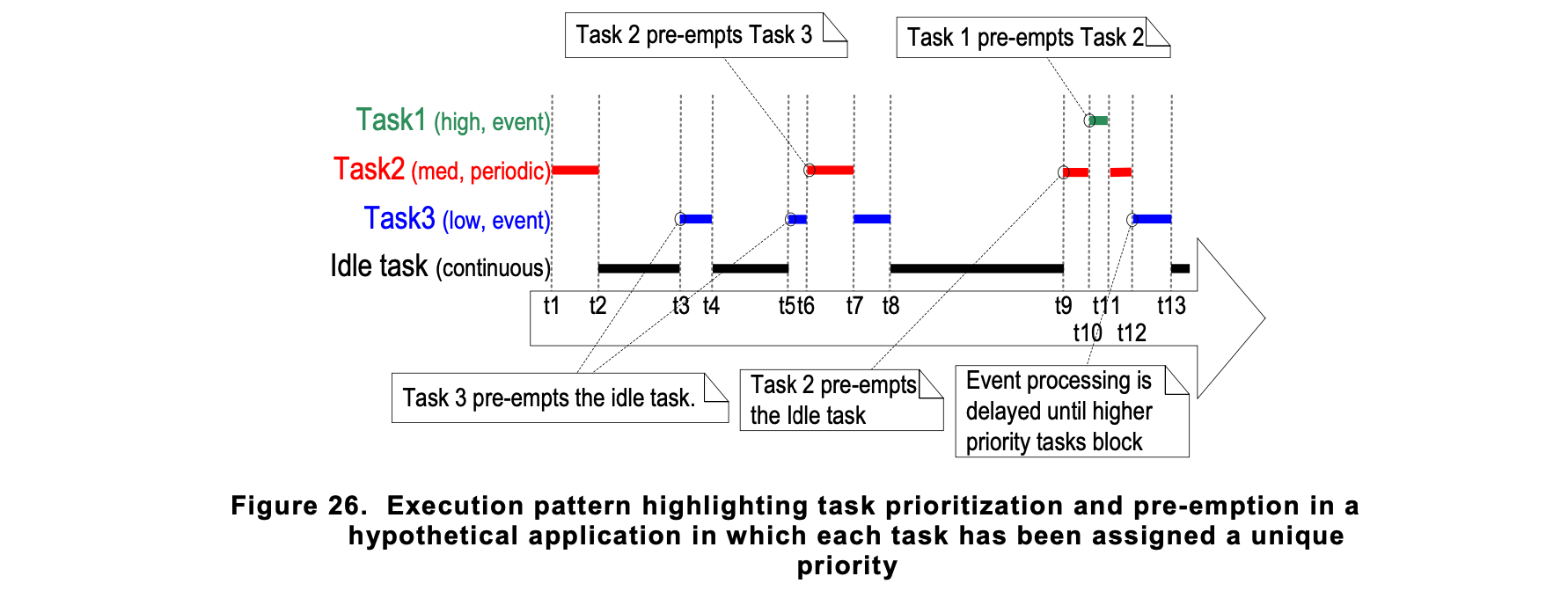
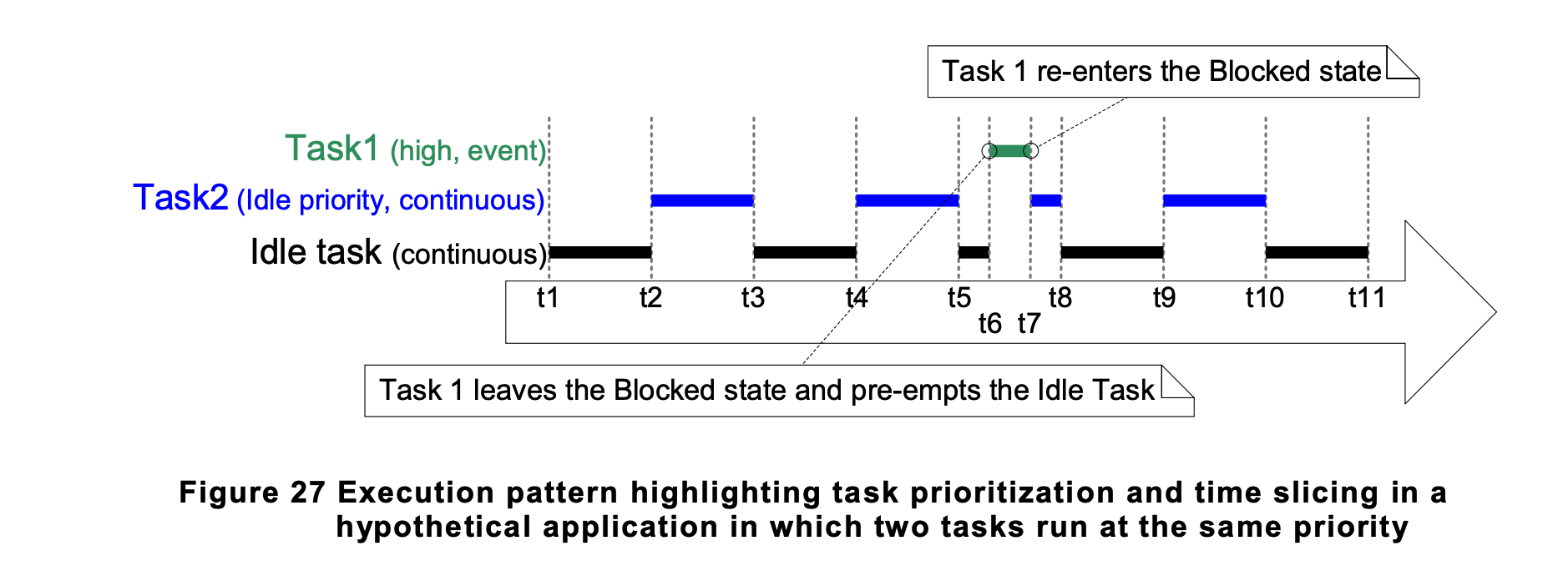 Time slicing lets equal-priority ready tasks take turns running.
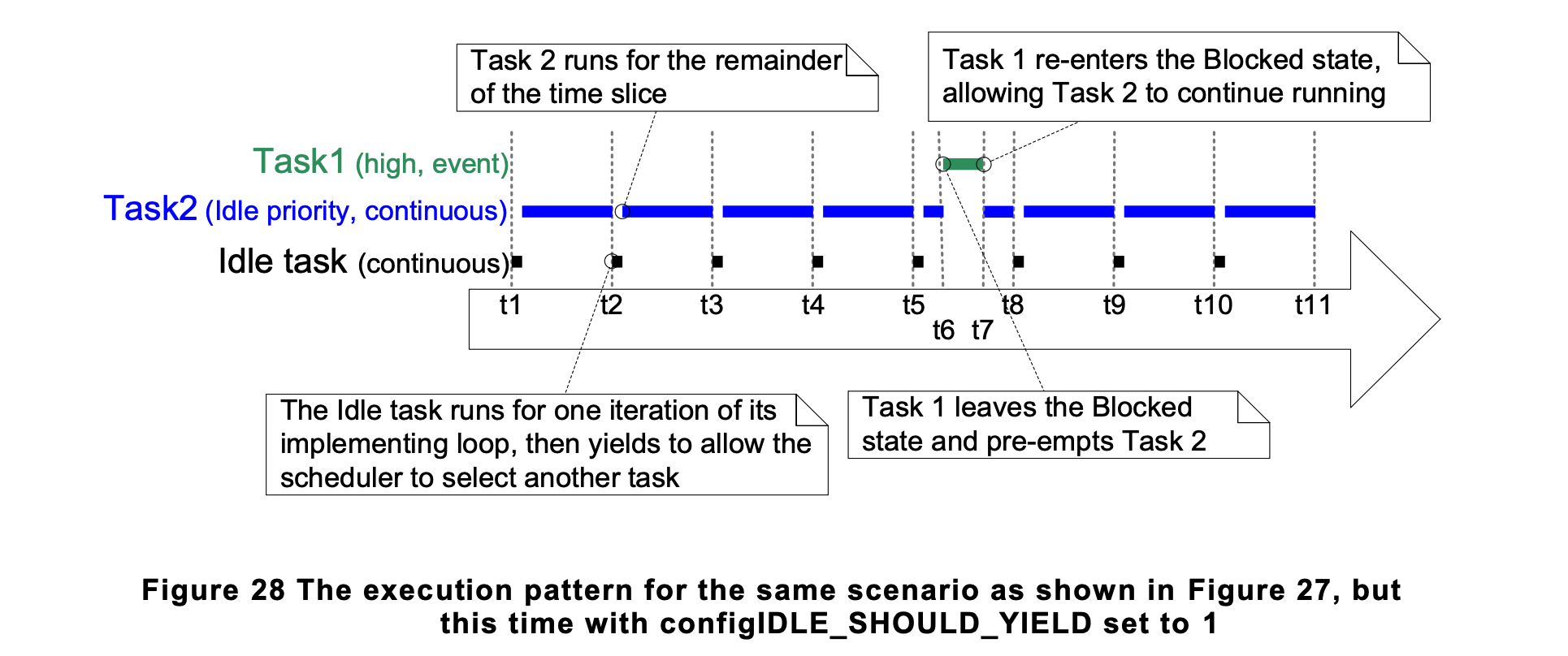 When configIDLE_SHOULD_YIELD is set to 1, the task selected to enter the Running state after the Idle task does not execute for an entire time slice, but instead executes for whatever remains of the time slice during which the Idle task yielded.
Prioritized Pre-emptive Scheduling (without Time Slicing)
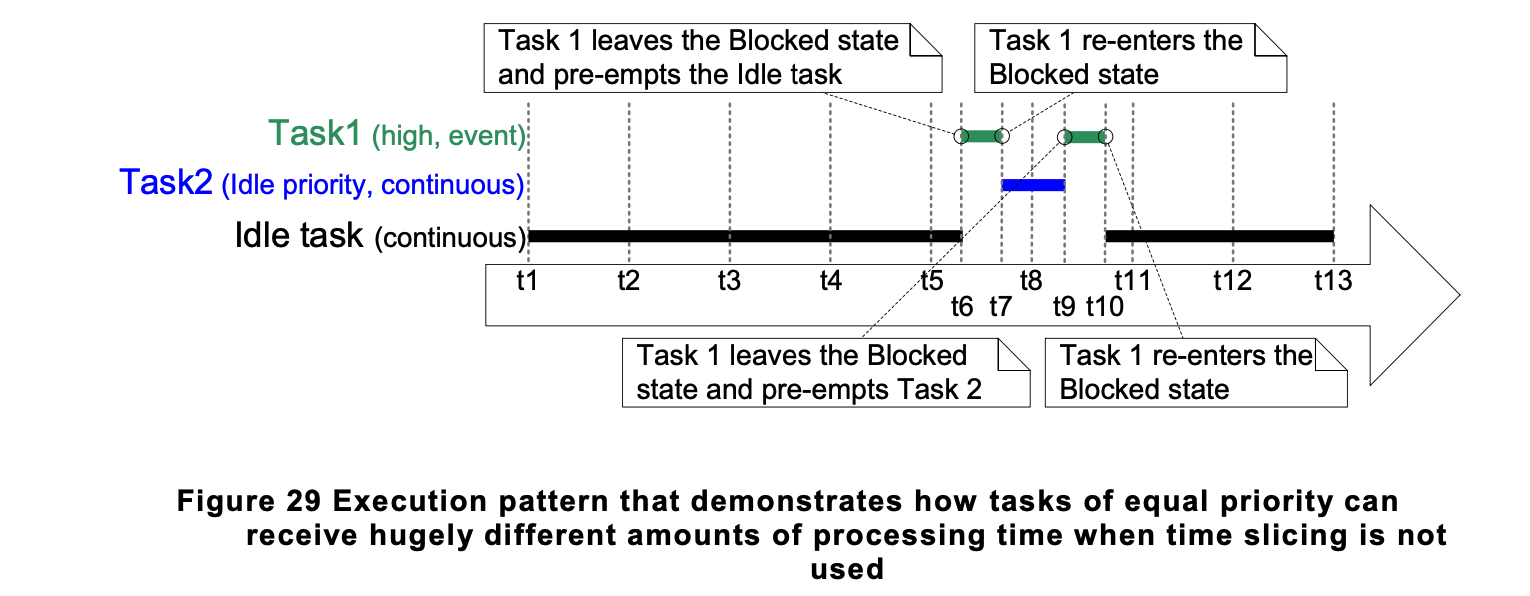
- fewer task context switches
- tasks of equal priority receiving greatly different amounts of processing time
Co-operative Scheduling
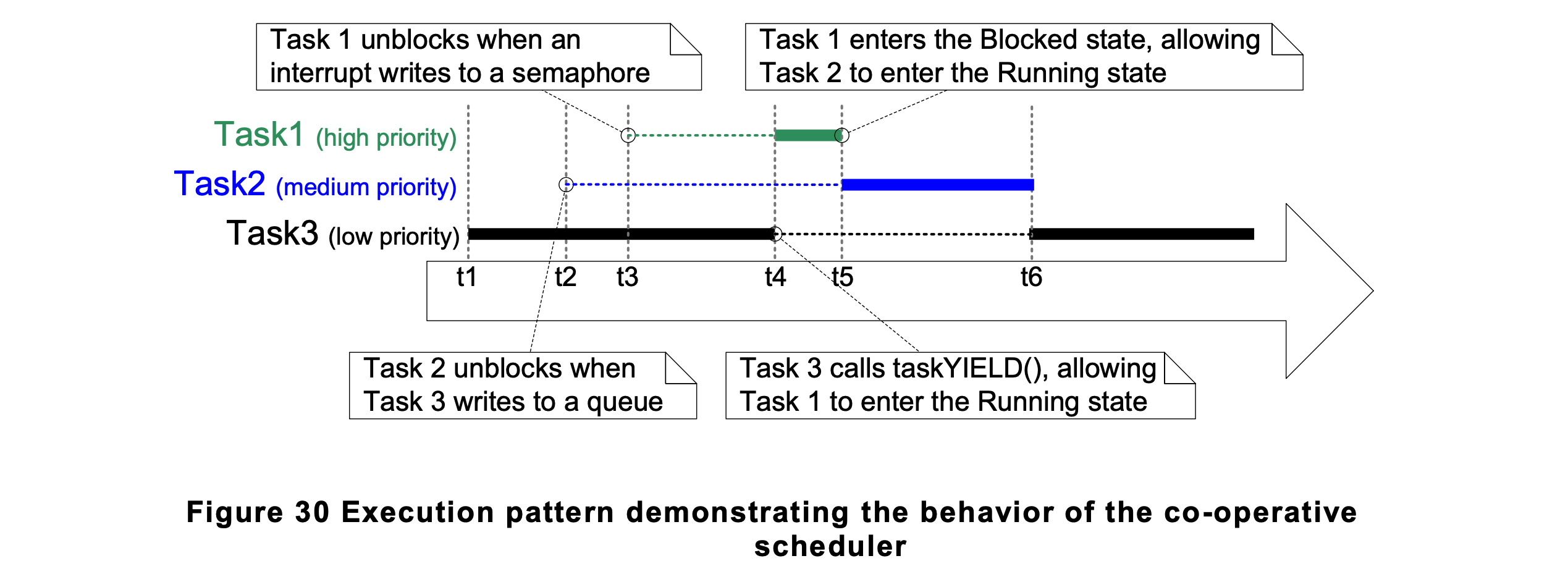
- Tasks are never pre-empted
- Time slicing cannot be used
Interrupt management
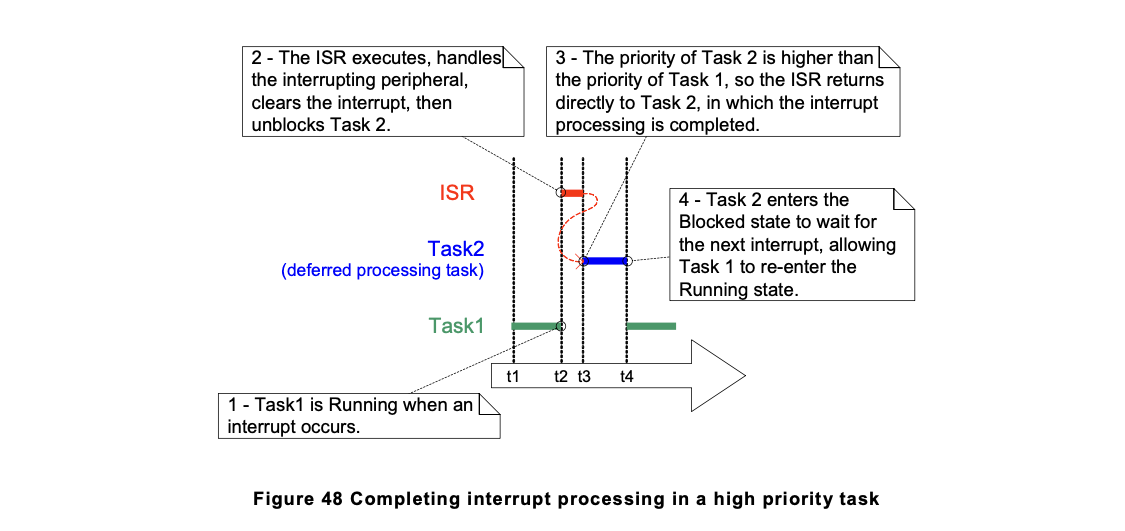
Keep interrupt service routines (ISRs) short: acknowledge or capture the event, then defer longer processing to a task. FreeRTOS provides ISR-safe APIs such as xTaskNotifyFromISR(), xSemaphoreGiveFromISR(), and xQueueSendFromISR().
Deferred interrupt processing
Give the deferred-handler task a sufficiently high task priority so that it can run promptly after the ISR unblocks it. Task priority and hardware interrupt priority are separate concepts.
Semaphores, queues, and task notifications
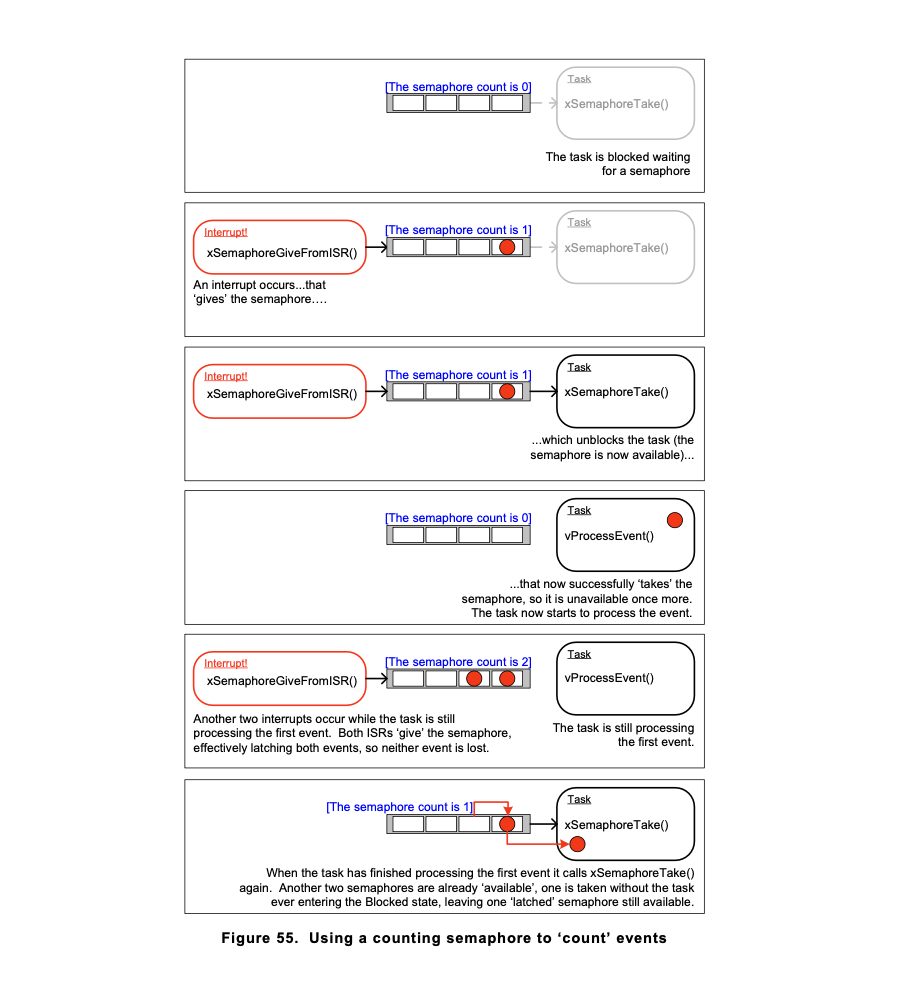
A binary semaphore records whether an event is available; a counting semaphore records how many events are pending. FreeRTOS implements semaphores using its queue infrastructure, but giving a semaphore does not copy an application payload.
Use a queue when the ISR must transfer fixed-size data to a task. Use a task notification when a single task is the recipient and the lighter-weight notification semantics are sufficient.
After an ISR unblocks a higher-priority task, request a context switch with the port-specific macro, commonly portYIELD_FROM_ISR().